TactileArena
Concept
Contact forces complement video-based behavioral measurement
Viewed from above, the paws of a walking rat are largely hidden beneath its body. Video and pose estimation describe the position and movement of the body, but not the load supported by each paw.
TactileArena measures the interaction directly at the surface. The floor is a dense array of pressure-sensing elements (taxels), so that every contact is recorded as a pressure image of the paw throughout stance. Overhead video, recorded on the same clock, provides body position and orientation; the tactile floor provides the contact loading.
Each recording provides the spatiotemporal parameters measured by conventional gait-analysis platforms such as CatWalk, including paw placement and stance and swing timing. It also provides quantities that video cannot capture: the load borne by each paw, the redistribution of weight among the paws, and the progression of load across each paw during stance.
Recorded data · 0.25× speed
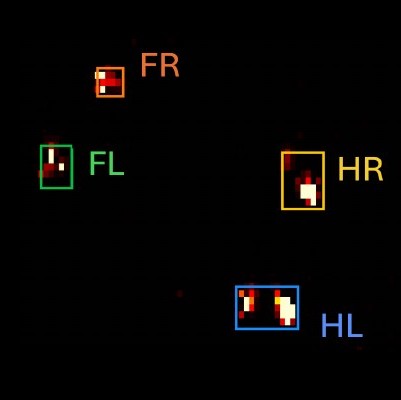
Simultaneous overhead video (top) and tactile floor (bottom) of the same walking sequence, both registered to sensor coordinates. Labels indicate automatic paw assignments by the analysis pipeline: FL, left forepaw; FR, right forepaw; HL, left hindpaw; HR, right hindpaw.
Biological application
Contact loading reveals deficits underestimated by gait timing
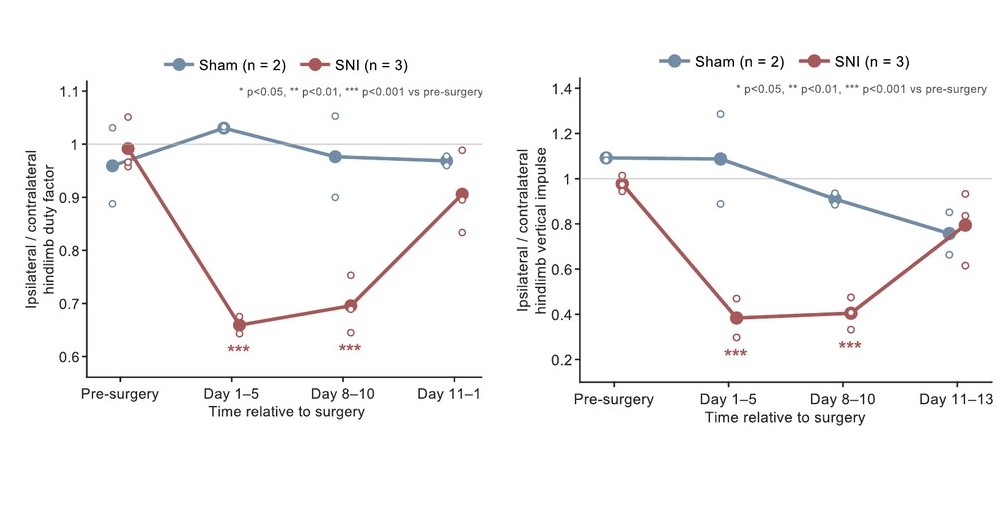
Rats were followed for two weeks after a left sciatic nerve pinch (three injured, two sham-operated). During the first postoperative days, injured animals continued to place the affected hindpaw on the ground. The reduction in its share of stance time was moderate, whereas the reduction in the load it supported was substantially larger.
Both ratios are close to 1 at baseline: the duty-factor ratio therefore decreased by approximately one third, whereas the loading ratio decreased by approximately 60%. Peak loading of the injured hindpaw decreased by 27%, and that of the contralateral hindpaw increased by 22–23%. Both ratios returned toward baseline by days 11–13.
Model estimates from linear mixed-effects models (p < 0.001 for both ratio changes). Statistical details are given in Results.
Sensing architecture
Large-area, high-density sensing at kilohertz rates
Large pressure-sensing surfaces conventionally trade sensing area and spatial resolution against acquisition speed, because every taxel must be measured in each frame. TactileArena overcomes this trade-off with adaptive compressive sampling: each readout board measures a fixed subset of taxels per frame, resolving at full density every region whose readings exceed a configurable pressure threshold, while a sparse background scan monitors the remainder of the surface.
01 · SENSING SURFACE
Modular sensor arrays
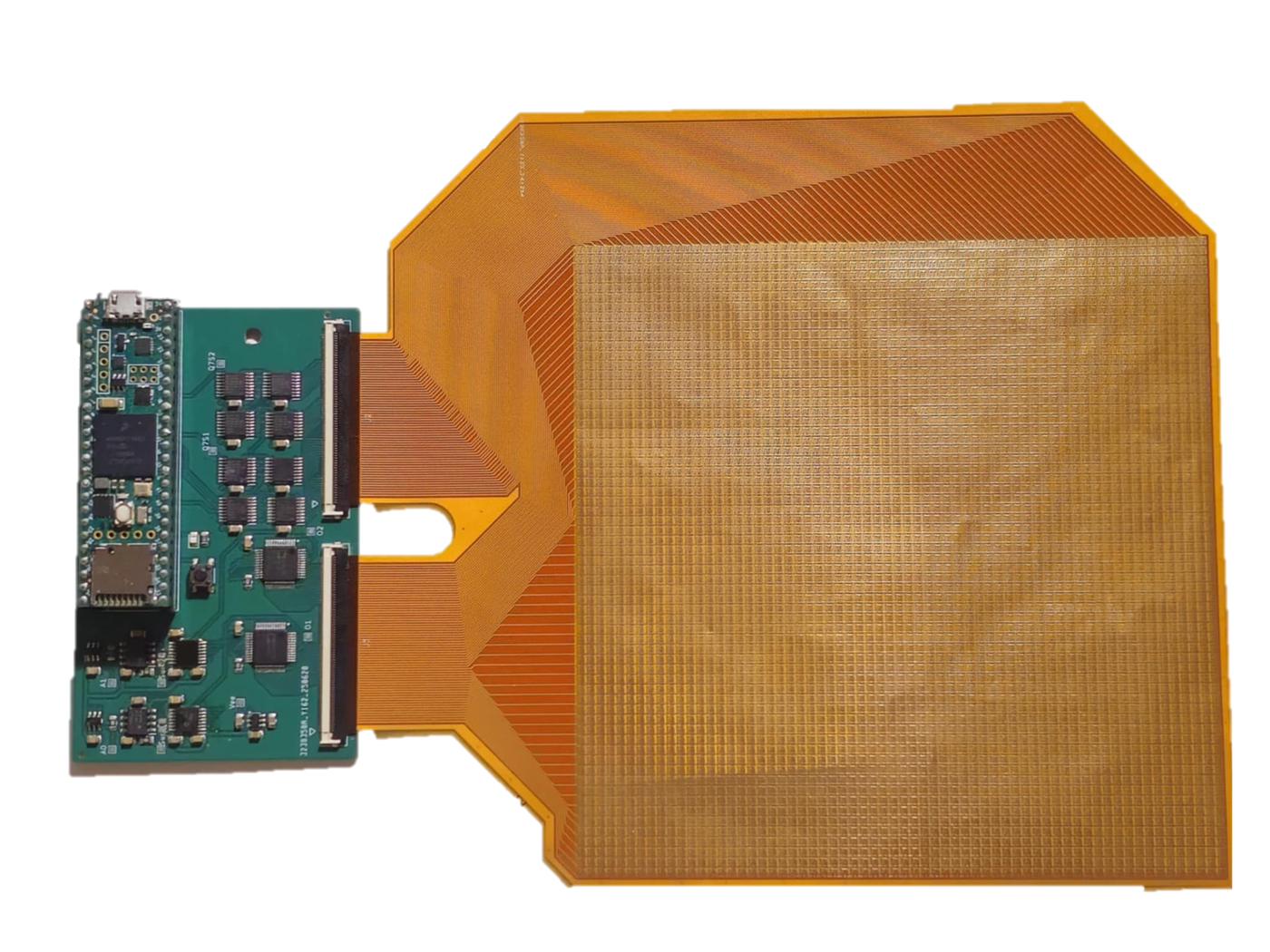
Each module is a flexible printed circuit carrying a 64 × 64 electrode array beneath a piezoresistive film and a waterproof cover; applied pressure reduces the local resistance of the film. Four modules, each with a dedicated readout board, form the 512-mm runway.
02 · ADAPTIVE SAMPLING
Adaptive compressive sampling
Each readout board measures 200 of its 4,096 taxels per frame. A coarse-to-fine background scan, shifted every frame, monitors the full module; any reading above the pressure threshold triggers recursive full-resolution sampling of its neighbourhood, so that each contact is resolved completely while unloaded regions are sampled sparsely.
03 · VIDEO FUSION
Camera-assisted paw assignment
Overhead video is recorded on the same clock and registered to the sensor grid, and a convolutional network localizes the tail base to provide body orientation. Contacts are then assigned to individual paws, correctly identifying 93.3% of 2,469 manually annotated contacts.
Overview video
Overview
Measurements
From whole-animal to within-step scales
Each recording supports measurements at three scales: displacement along the arena, load distribution among the four paws, and pressure dynamics within each paw contact.
Contact morphology and timing
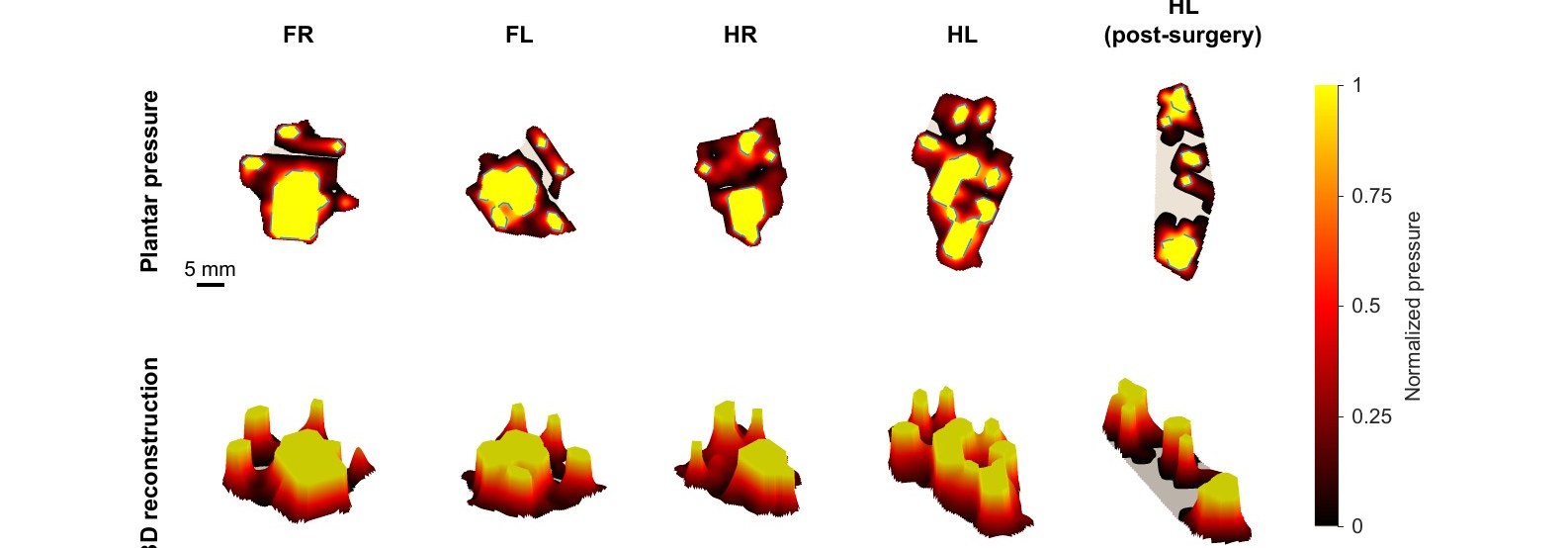
Paw-resolved pressure maps, contact area and shape, and stance and swing timing for all four limbs. After injury, contacts of the injured hindpaw became smaller and more elongated.
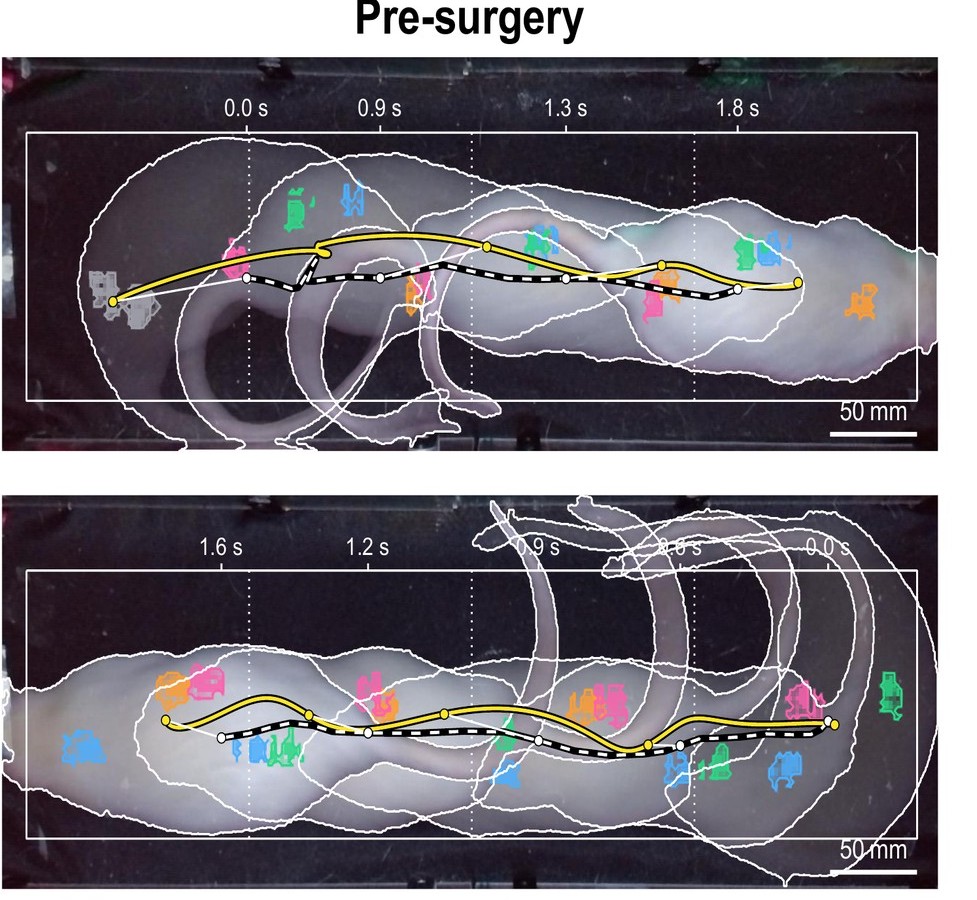
Centre of pressure
The whole-animal centre of pressure describes how body weight is distributed across the supporting paws, a quantity distinct from the body outline captured by video.
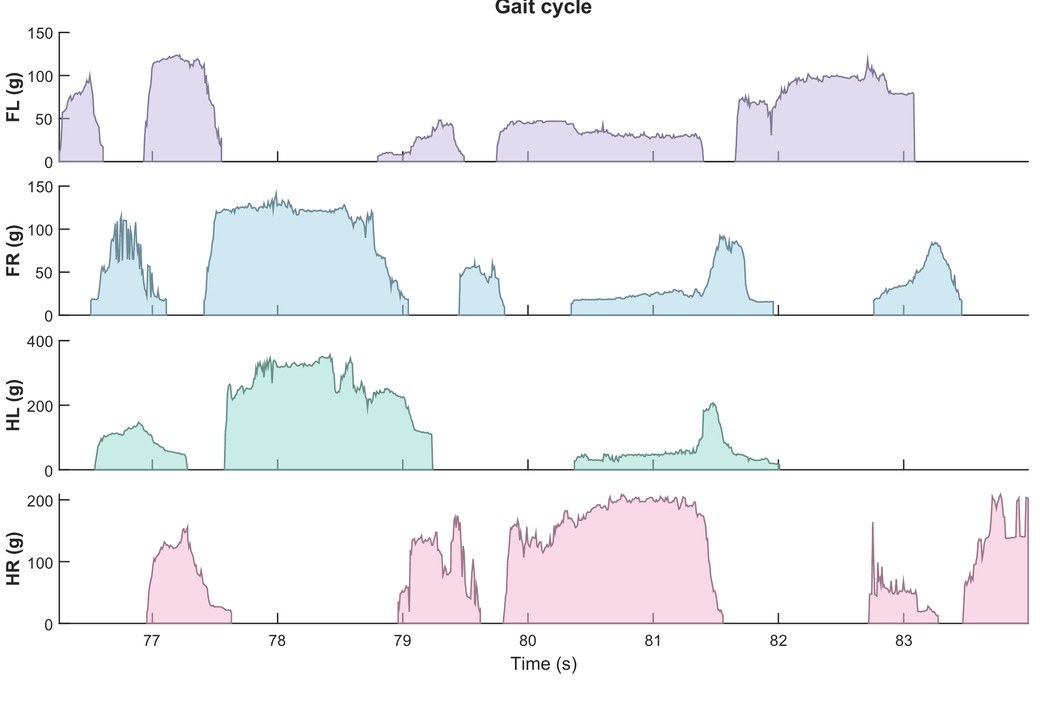
Within-step loading dynamics
Mass-equivalent loading of each paw at approximately 1 kHz. For stances of 0.2–0.5 s, cumulative-loading error remained below 2% down to 50 Hz and increased to approximately 10% at 10 Hz.
Modularity
Reconfigurable sensing surfaces
Because the sensing surface is assembled from independent modules, the same hardware can be arranged in other geometries. Here, the four modules form a square open-field arena that records three rats simultaneously.
Future applications include:
- larger or differently shaped arenas and other species, following recalibration;
- integration with markerless pose estimation, relating contact loading to limb and body posture;
- synchronized neural or muscle recordings, linking the mechanics of individual steps to sensorimotor control, including perturbations triggered at defined phases of contact;
- shear sensing at comparable spatial resolution, extending measurements to tangential forces.
Three rats · 128 × 128 taxels
Resources
Open hardware, software and data
Hardware
Four flexible-PCB sensor modules, four Teensy 4.1-based readout boards, piezoresistive film and a waterproof cover; approximately US$550 in parts per runway (approximately US$140 per module). KiCad design files, fabrication files and an assembly video are provided.
Citation
Please cite the preprint (bioRxiv, 2026):
@article{lu2026tactilearena,
  title   = {Scalable high-density tactile arenas for measuring ground-contact forces in freely moving animals},
  author  = {Lu, Weiwen and Slepyan, Ariel and Perkins, Pierce and Ascani Orsini, Alessandro and Quinn, Kiara and Thakor, Nitish V.},
  journal = {bioRxiv},
  year    = {2026},
  doi     = {10.64898/2026.10.22.760735},
  url     = {https://www.biorxiv.org/content/10.64898/2026.10.22.760735v1}
}